
Our advice
Senior dogs and chewing
An older dog needs to chew just as much as before. What has changed is not the urge, it is what the mouth can take — and that change is invisible from the outside.
Just want to know what to give him? Go straight to the products
Age does not remove the need to chew
Chewing is not a puppy game that dogs grow out of. It is a core behaviour, like sniffing or digging, and it does not fade with age.
In an older dog it becomes more useful, not less. Walks get shorter, running games stop, encounters with other dogs grow rare. The day empties out, and that emptiness fills with sleep, then with restlessness.
Many dogs over ten develop cognitive decline: evening pacing, aimless whining, disrupted sleep. A chewing session in the late afternoon gives that part of the day a shape, better than a stroke or a treat, because it lasts and it demands concentration.
Withholding chews from an old dog out of caution therefore trades one risk for another. The right answer is not to stop, it is to adapt.
What changes in the mouth after eight
Four changes stack up, and none of them is visible without looking closely.
Enamel wears down. The canines and molars of a twelve-year-old are shorter, flatter, sometimes browned at the tip. A worn tooth resists sideways pressure less well than a new one.
Micro-cracks accumulate. A tooth may have carried an invisible fissure for years, picked up on a stone or a wire fence. It holds. Then one day, on a hard material, it gives way — and the chew of the day gets the blame, when all it did was reveal.
Periodontal disease advances. It already affects the majority of dogs over three; by ten it is often well established. A tooth whose bone support has receded becomes a lever: the chewing force no longer applies to an anchored tooth, but to one that moves.
Teeth are missing. After an extraction, the dog shifts all the work to the other side of the mouth. He keeps chewing, apparently normally, loading the remaining teeth twice as hard.
Redo the thumbnail test, and set the bar higher
The rule holds at any age: if you cannot mark the surface with your thumbnail, it is probably too hard for your dog's teeth.
With a senior, simply apply it more strictly. What was fine at three is not necessarily fine at eleven on the same jaw — because it is no longer the same jaw.
A second test, more telling still, comes afterwards. Let your dog work for ten minutes, then take the chew back and look at it. If it shows scratches, grooves, a rasped surface, the exchange is going the right way: the chew is the one wearing down. If it is untouched, the tooth absorbed everything.
Whole deer antler already sits at the limit of that rule for a healthy adult. For most older dogs it falls on the wrong side of it.
One dental check a year after eight is worth more than any home test. It catches the cracks and loose teeth you will never see.
Arthritis changes how a dog chews, not just how he walks
A dog chews lying down, chest on the floor, both front paws pinning the chew. Holding that position means keeping the elbows and shoulders flexed for twenty minutes.
With arthritis it becomes painful. The dog settles, works for two minutes, gets up, lies down differently, then gives up. The obvious conclusion is that he does not like the chew. It is not the chew that hurts, it is the position.
Three adjustments usually fix it: a thick mat or a firm cushion instead of tiles, a flat stable piece rather than one that rolls away and has to be chased, and two shorter sessions in the day rather than one long one.
You can also hold the chew yourself for the first few minutes. Plenty of old dogs get going again once that holding work is taken off them.
What still works, and what no longer does
Coffee wood is the first choice. It is the softest of our hard woods: it crumbles into fine particles under the tooth instead of presenting a solid block, and that is exactly the profile a worn set of teeth needs.
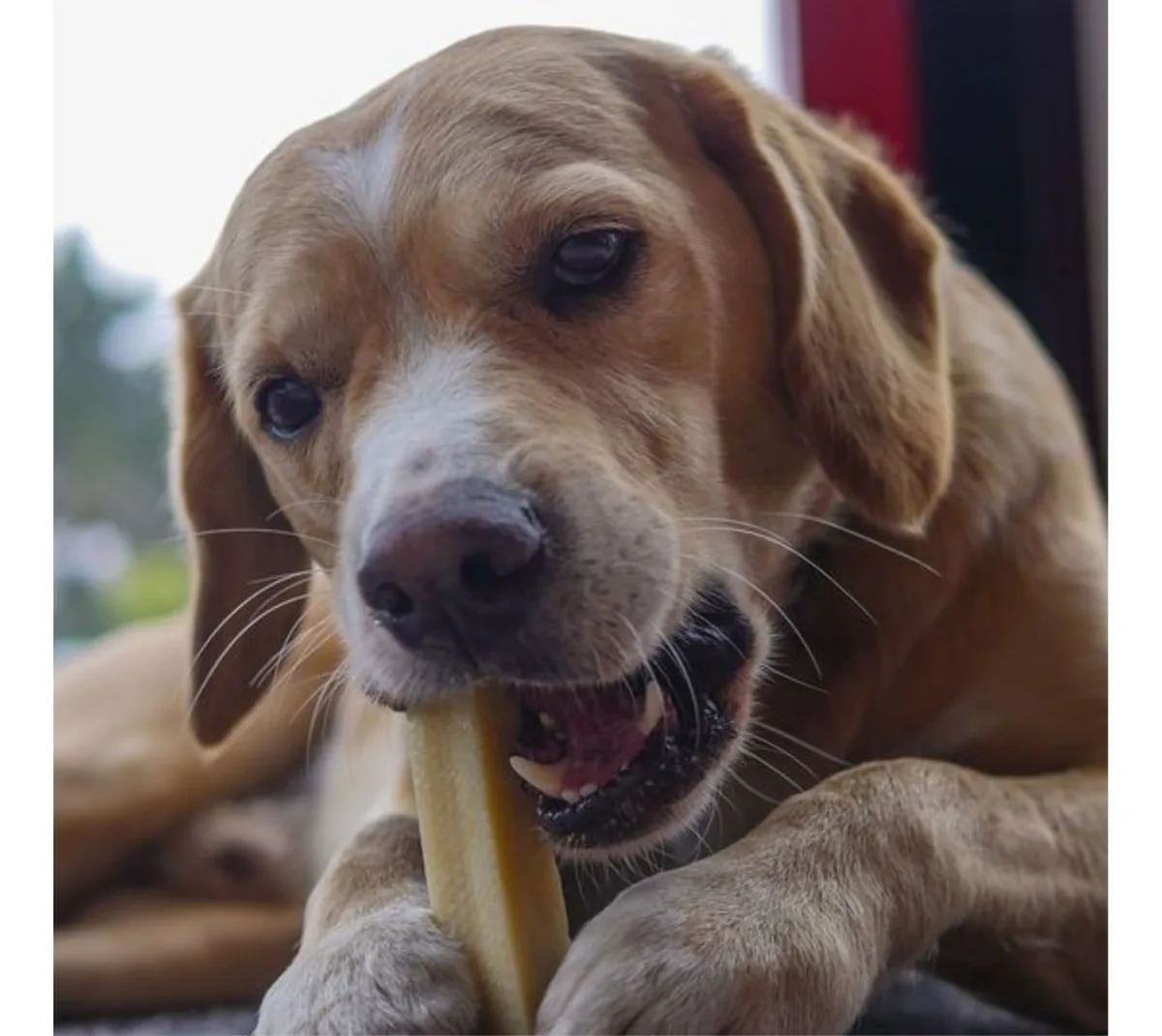
Yak cheese comes next. It softens gradually with saliva, which makes it the most forgiving material in the range. Its milky smell also wakes up dogs whose sense of smell is fading — and appetite usually declines before chewing ability does.
Split deer antler stays possible if the teeth have been checked and the dog is not a crusher. With the marrow exposed from the start, he does not have to attack the hardest part to reach the flavour.
Whole deer antler should be set aside by default. Keep it only for a senior whose teeth have been examined, and who chews by patient rasping rather than brute pressure — that dog exists, but he is the exception.
One safety point age does not change: do not drop a size because your dog is old. A chew that is too small gets swallowed or wedged between the molars. Size follows body weight, exactly as it did at three.
The signs that mean stop
A fractured tooth hurts, but a dog almost never shows it. He goes on eating, asking, wagging. It is the details that give it away.
Watch for: chewing always on the same side; picking the chew up, dropping it, coming back, dropping it again; drooling more than usual, or saliva tinged pink; breath that turns bad suddenly; rubbing a cheek along the floor or the sofa; refusing a chew he was asking for last week.
A sudden refusal is a signal, not a mood. In an old dog it points to pain far more often than to boredom.
In any of those cases, take the chew away and book an appointment. A fractured tooth does not heal on its own, and the infection that follows eventually reaches the bone.
The products that answer this need
- Coffee woodThe density of hardwood without the hardness of antler. Our pick for small dogs, seniors and careful jaws.
- Yak cheeseThree ingredients, centuries of Himalayan tradition, and a milky aroma very few dogs can resist.
- Split deer antlerAll the qualities of deer antler, with the marrow accessible from the start. The best way into natural chew to
The questions we get asked
At what age is a dog a senior?
It depends entirely on size. A mastiff or a German shepherd enters that stage around six or seven; a small dog under ten kilos often not before eleven or twelve. Go by the state of the teeth and the ease of movement rather than the birth date.
My dog has lost several teeth. Can he still chew?
Yes, in most cases, provided you move to a softer material — yak cheese first. Ask your vet which teeth are still doing the work: it is the back molars that chew, not the front incisors. A dog who has lost his incisors chews perfectly well.
He has lost interest in everything. Is that just age?
Be wary of that explanation. A sudden loss of interest in chewing is one of the first signs of dental pain, and it often comes months before the problem becomes visible. Have his mouth looked at before putting it down to old age.
Isn't yak cheese too rich for an older dog?
It is rich, and many older dogs gain weight because they move less. Count it inside the daily ration rather than on top of it, and offer shorter pieces. A dog who is overweight or has had pancreatitis needs veterinary advice before any fatty chew.
Can a chew be softened to make it easier?
For yak cheese, yes: the last piece, microwaved for thirty to sixty seconds, puffs up and turns crisp, and is very easy to finish. Let it cool completely. Never soak wood, though — moisture does not soften it, it only encourages bacteria.
Should chewing stop altogether at some point?
Rarely, and never as a matter of principle. You adapt the material, the size and the length of the session. You stop only on veterinary advice, when the mouth can no longer take any pressure — and you replace it with scent work, which produces the same mental tiredness without loading the teeth.
Which chew for your dog?
Four questions, forty seconds. You get the material, the precise size, and above all the reason — including when the answer is “none, not yet”.
Our advice
Understanding your dog's behaviour, and what chewing can change about it.
- My dog destroys everything when I leaveYou come home, the skirting board is gnawed, the sofa gutted. Before looking for a solution…
- My dog is bored: the signs and what to doA bored dog does not sit quietly waiting for it to pass. He invents an activity of his own —…
- Tartar in dogsPeriodontal disease affects the majority of dogs over three years old, and it is almost always…
- Which chew for a puppyA puppy nibbles everything, and that is normal. But most natural chews — ours included — are…
- Antler, horn, rawhide: what each material is worthThe shelf is crowded and every promise sounds alike. Three questions are enough to place any…
The Vitalipets guide
Our choosing guide, free
Join the Vitalipets community: you get our guide “Choosing the right chew” straight away, then our chewing know-how once or twice a month. Never more.
- The guide “Choosing the right chew”, as a PDF and online
- Sent immediately, with no purchase required
- Plain-English advice once or twice a month. No spam
- One-click unsubscribe, any time

Get the guide
Your data stays with us. Never sold, never shared. One-click unsubscribe.