

The Vitalipets guide
Choosing the right chew for your dog
Concrete markers, no jargon. This guide is not about picking the prettiest product, but the one your dog can chew for a long time without risk.
Why your dog needs to chew
A dog that chews is not killing time: it is meeting a need. Chewing releases endorphins, brings nervous tension down and occupies the mind other than through restlessness. It is also the most natural dental hygiene there is — the mechanical friction lifts plaque before it hardens into tartar.
A dog denied this outlet finds it elsewhere: skirting boards, chair legs, shoes. The problem is almost never the dog. It is the absence of an authorised object of the right size.
The three questions, in this order
What size is he? This determines the size of the piece. It is the safety criterion, the one you do not negotiate.
What kind of chewer is he? This determines the material. An intense chewer will destroy in three days what would occupy another dog for a month.
Has he already chewed hard material? This determines how to introduce the product, and sometimes to start with a different one.
A 30 kg dog that has never chewed anything but rubber does not start with a whole antler. Size says “large”, but experience says “start softer”.
Assessing your dog's temperament
This is the most useful criterion and the least obvious. It depends neither on breed nor on weight: two labradors of the same age can sit at opposite extremes. Watch him with his current toys.
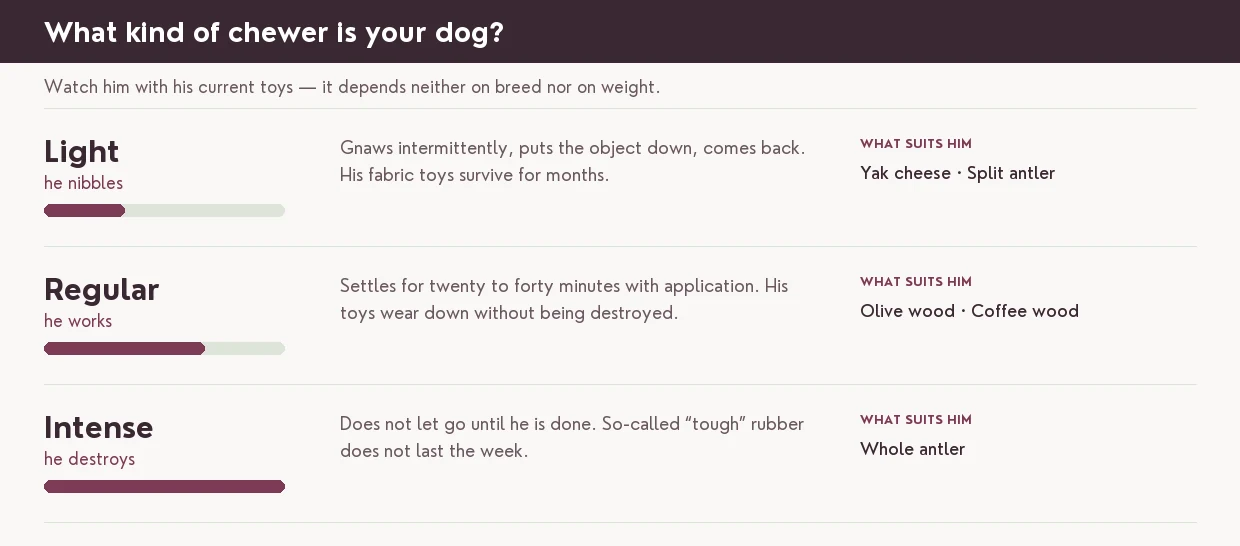
Light chewer — he nibbles. He picks the object up, gnaws intermittently, puts it down, comes back later. His fabric toys survive for months. He needs a soft, fragrant material that gives quick results: yak cheese, or split antler whose exposed marrow draws him in immediately.
Regular chewer — he works. He settles down, chews for twenty to forty minutes with application, then moves on. This is the most common profile. He needs a material that lasts several weeks without being discouraging: olive wood, or coffee wood for gentler jaws — a small build or a senior dog.
Intense chewer — he destroys. He takes on the object methodically and does not let go until he is done with it. So-called “tough” rubber toys do not last the week. He needs the densest material: whole antler, and nothing else.
A case apart: the crusher. Some dogs do not wear their toys down, they try to break them with one bite of the molars. On very hard material, that action risks a fractured tooth. If your dog does this, rule out whole antler and go for split antler or yak cheese instead. If you know of any dental fragility, speak to your vet before offering anything hard.
The right size: the rule that overrides everything
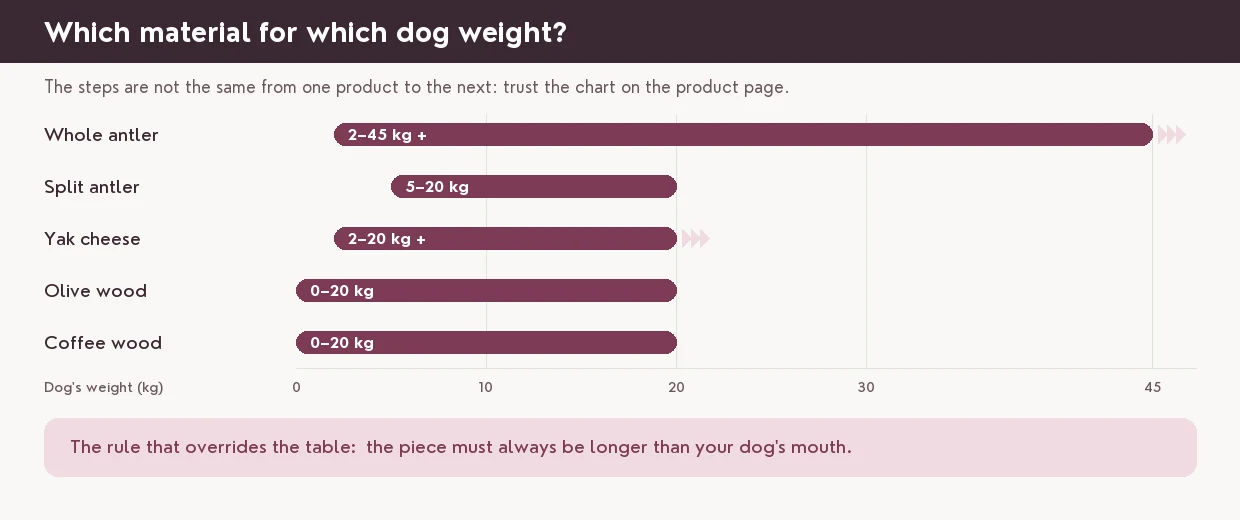
The rule, valid for every product: the piece must always be longer than your dog's mouth. As long as he cannot fit it in entirely, he cannot swallow it.
There is no single size chart. Each material has its own steps, and they do not line up: antler is sized by the weight of the piece and goes up to 45 kg dogs, while olive wood and coffee wood are sized by length and stop at 20 kg. An "L" therefore does not mean the same thing from one product to the next.
Trust the chart published on the page of the product you are considering: it describes the material you will actually receive.
If you hesitate between two sizes, take the larger one. An oversized piece has no drawback: it simply lasts longer. An undersized piece is a choking risk.
And if your dog is heavier than the largest step offered for a material, that material is not for him. Antler is the only product in the range sized for large dogs.
Which product for which dog
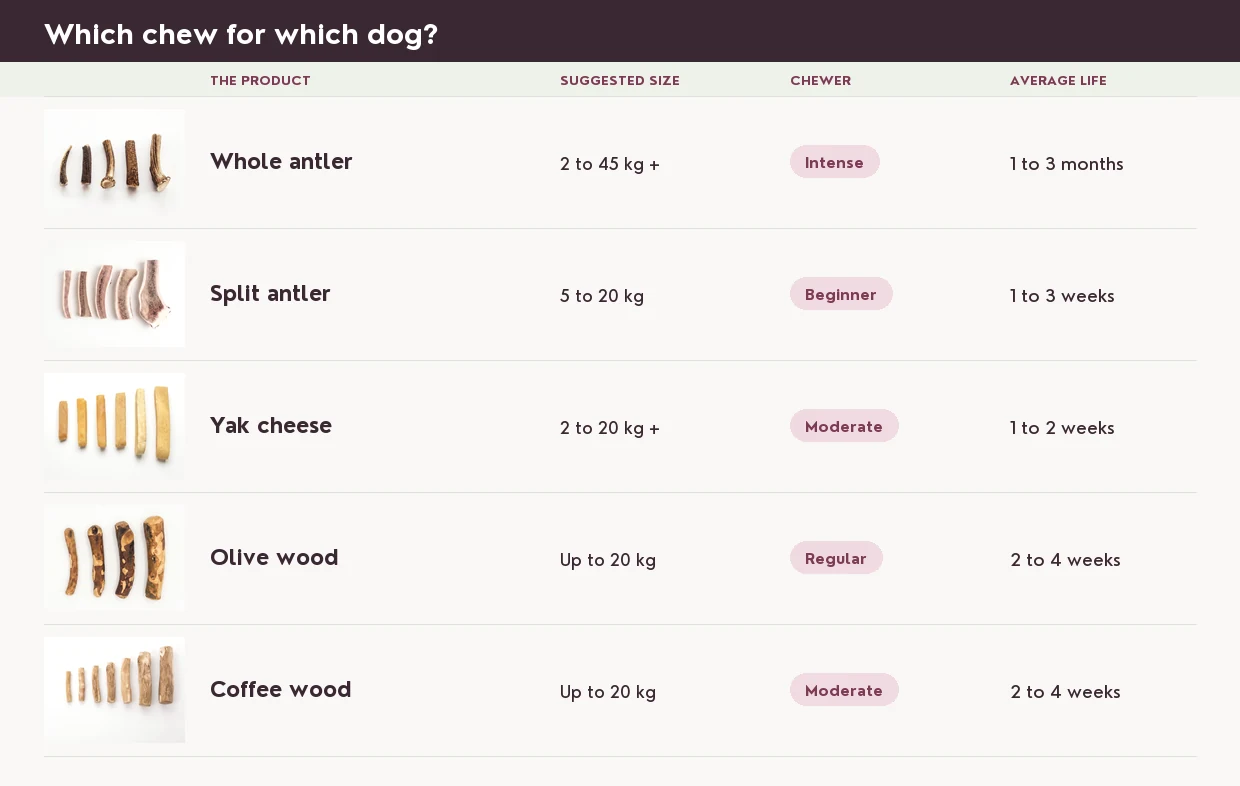
The table below crosses the two criteria that matter: size and temperament.
The first sessions
A dog discovering a hard material should not spend an hour on it straight away. The jaw and gums need to adjust.
Days 1 to 3: 10 to 15 minutes per session, under your supervision. Take the piece back afterwards, without making it a conflict — offer a swap.
Days 4 to 7: up to 30 minutes, once or twice a day.
After that: 20 to 40 minutes a day, in sessions. This is not an object to leave freely available at all times.
Some dogs carry the piece around for several days before really starting to chew it. That is normal, especially with olive wood. Let him come to it. If your dog chews a yak cheese too fast, lightly dampen the surface: this softens the outer layer and slows the pace.

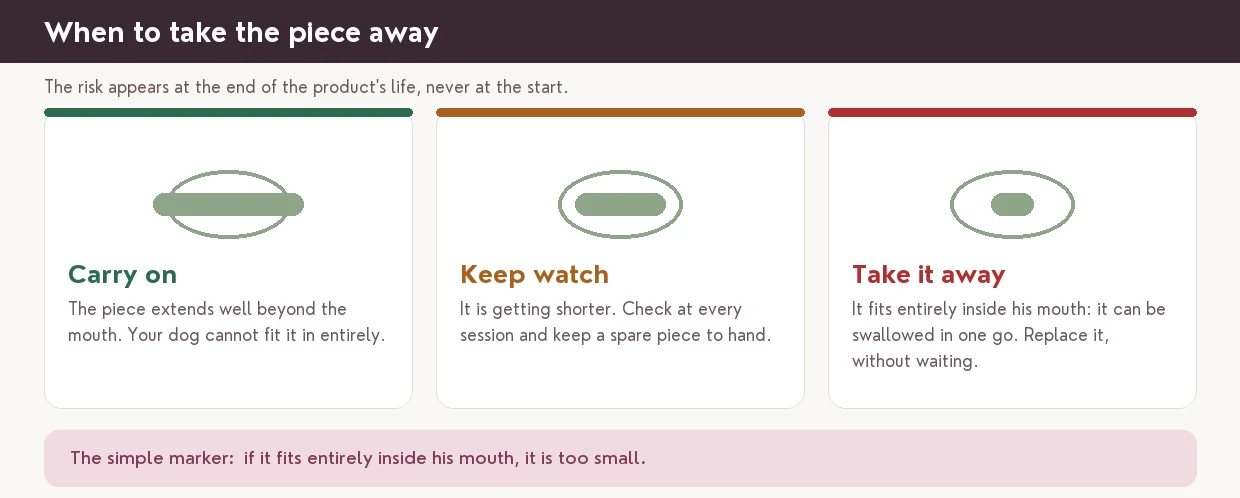
When to take the piece away
This is the only genuinely critical instruction in this guide.
Take the piece away and replace it as soon as it becomes small enough to be swallowed whole. The simple marker: if it fits entirely inside your dog's mouth, it is too small.
The risk appears at the end of the product's life, never at the start. A reduced piece can be swallowed in one go and become lodged.
Two other reasons to remove it: olive wood that splits deeply along its whole length, and long fibres coming away from a coffee wood — remove those as they appear.
For yak cheese, the last piece is not wasted: a few seconds in the microwave and it puffs up into a crisp, airy mouthful. Let it cool completely before giving it.
The mistakes that come up most often
Guessing the size. This is the most frequent mistake and the only one that carries a real risk. Weigh your dog, take the band above if you hesitate.
Leaving the product freely available. A chew is given in sessions, then put away. Left out permanently, even a moderate chewer eventually gets through it — and reaches the critical size without anyone noticing.
Starting too hard. A dog discouraged by a whole antler will not easily come back to the material. Better to succeed with a softer product and work up.
Confusing “not interested” with “doesn't like it”. Many dogs ignore a new object for two or three days. Leave it lying around, do not push it on him.
Forgetting the age. All our products are for dogs over six months, once the adult teeth are in.
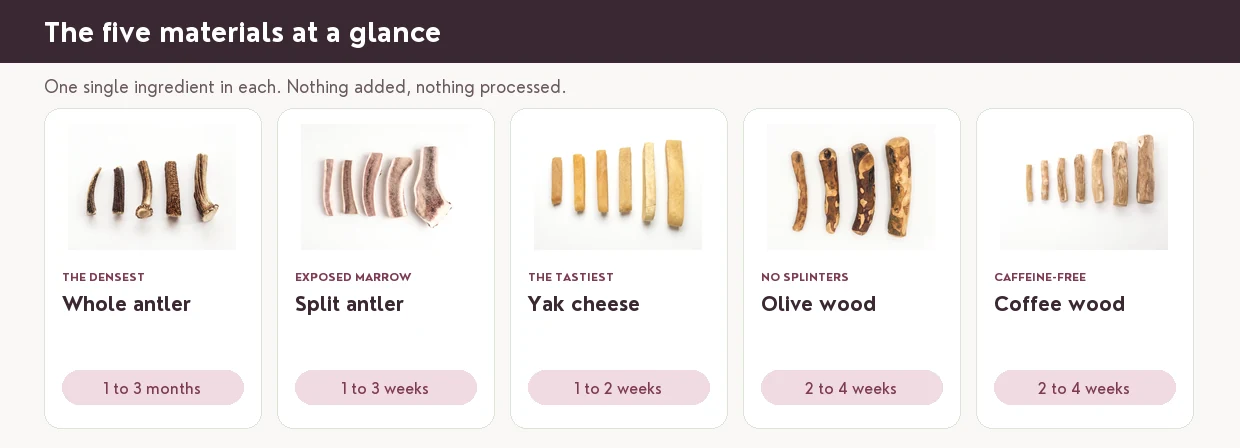
The five materials at a glance
One last thing
A chew does not replace supervision. No product, whatever its quality, should be given to a dog left alone during its first sessions.
And if your dog has a known dental fragility, a fractured tooth or a sore gum, ask your vet before offering hard material. That is common sense, not a disclaimer.
A question about a size or a product?
Write to us — we answer ourselves.
Which chew for your dog?
Four questions, forty seconds. You get the material, the precise size, and above all the reason — including when the answer is “none, not yet”.
Guides by material
A detailed guide for each of our five products.
Our advice
Understanding your dog's behaviour, and what chewing can change about it.
- My dog destroys everything when I leaveYou come home, the skirting board is gnawed, the sofa gutted. Before looking for a solution…
- My dog is bored: the signs and what to doA bored dog does not sit quietly waiting for it to pass. He invents an activity of his own —…
- Tartar in dogsPeriodontal disease affects the majority of dogs over three years old, and it is almost always…
- Which chew for a puppyA puppy nibbles everything, and that is normal. But most natural chews — ours included — are…
- Senior dogs and chewingAn older dog needs to chew just as much as before. What has changed is not the urge, it is…
- Antler, horn, rawhide: what each material is worthThe shelf is crowded and every promise sounds alike. Three questions are enough to place any…
The Vitalipets guide
Our choosing guide, free
Join the Vitalipets community: you get our guide “Choosing the right chew” straight away, then our chewing know-how once or twice a month. Never more.
- The guide “Choosing the right chew”, as a PDF and online
- Sent immediately, with no purchase required
- Plain-English advice once or twice a month. No spam
- One-click unsubscribe, any time

Get the guide
Your data stays with us. Never sold, never shared. One-click unsubscribe.