
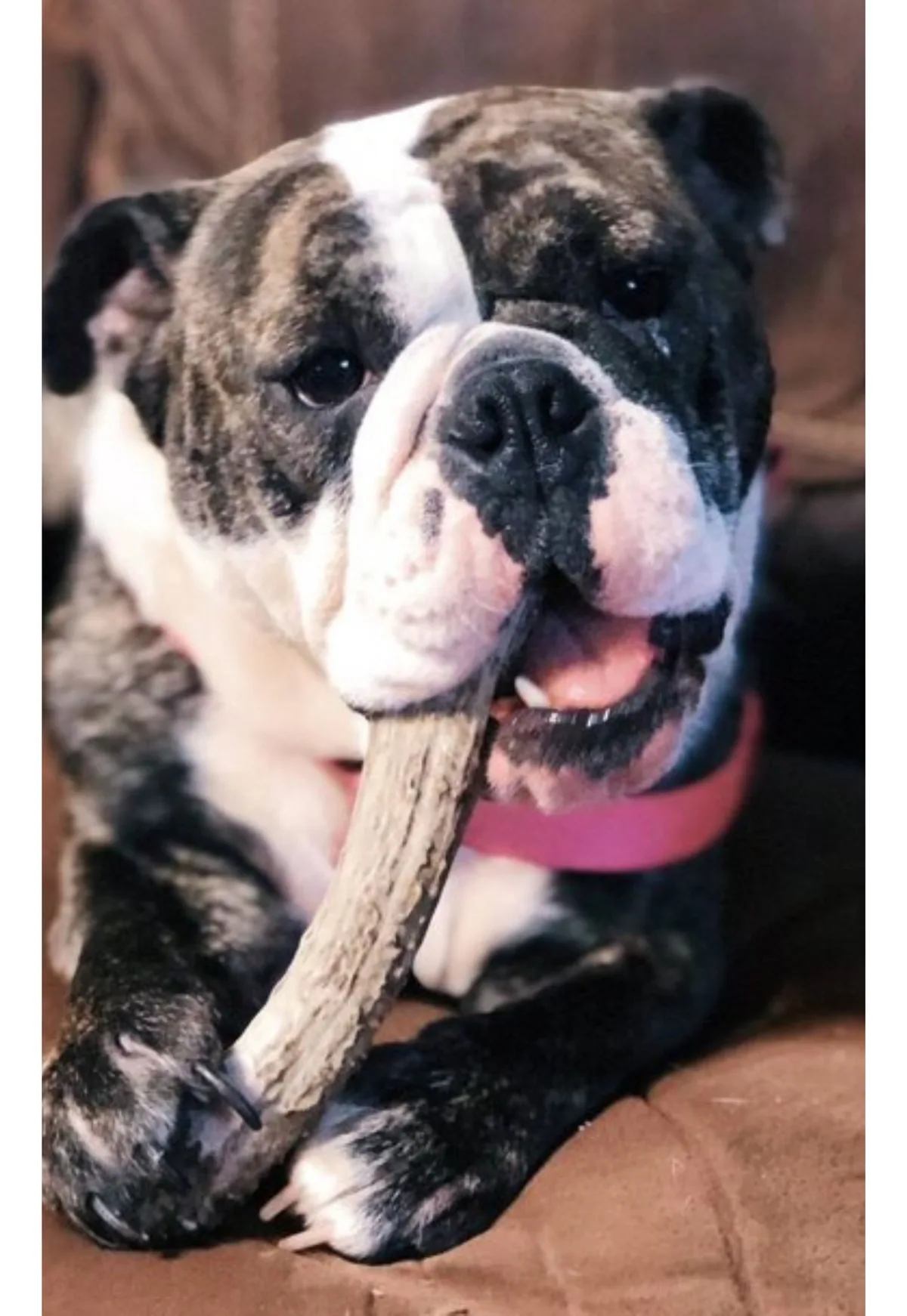
Our advice
My dog is bored: the signs and what to do
A bored dog does not sit quietly waiting for it to pass. He invents an activity of his own — and you rarely like it. Here is how to recognise it, and why longer walks almost never solve the problem.
Just want to know what to give him? Go straight to the products
The signs, including the ones nobody reads as such
Some are obvious: destruction, barking with no trigger, restlessness at the end of the day. Others go unnoticed because they look like character traits.
He follows you from room to room and lies down again every time you stop. That is not attachment, it is the only event available in his day.
He demands attention constantly. He puts a paw on you, brings a toy, barks at nothing. He has learned that this produces interaction — and a telling-off is still interaction.
He sleeps a great deal, more than before. In an adult dog, sleep that lengthens with no medical reason is often sleep by default: there is nothing else to do.
He develops repetitive behaviours: licking the same spot on a paw, chasing his tail, pacing. These warrant veterinary advice, because they can become entrenched.
He digs, gnaws or licks the floor. A dog gnawing a table leg at four in the afternoon is not testing your authority: he is filling empty time.
Why walking more is not enough
It is everyone's reflex, and it rarely gives the expected result. There are two reasons.
The body adapts, the mind does not. A dog walked more becomes fitter. You raise the fatigue threshold without ever reaching it — and end up with a dog in better shape who is bored exactly as much.
Walking on the lead is poor in information. The dog moves forward without choosing his direction or stopping where he wants. What tires a dog is processing information, not covering distance.
The demonstration is easy to run at home. Half an hour where he picks the route, sniffs every post and follows a trail will tire him more than an hour walking in a straight line. A dog who has sniffed well comes home and sleeps; a dog who has walked well comes home and paces.
What genuinely tires a dog out
In order of effectiveness, from the best to the least return on time spent.
Scent work. By far the most effective. Scatter his ration in the grass or in a snuffle mat and he will spend twenty minutes searching intently. Hide three treats in a room and have him find them. Ten minutes of scent work is worth an hour of walking.
Chewing. It works differently: it does not tire, it calms. The repetitive action releases endorphins and brings the arousal level down. It is the only tool on this list that works without you — and therefore the only one available when you are not there.
Occupation toys. Snuffle mats, dispensers, stuffable toys. Effective, but most are emptied in five to ten minutes.
Obedience work in short sessions. Five minutes learning a new trick tires a dog surprisingly fast. It is also interaction, which solves part of the problem.
Meetings with other dogs. Useful, but to be measured out: some dogs come away over-excited rather than settled.
The time when you are not there
This is the real subject. Everything above requires your presence, except one thing: what you leave your dog when you go.
Give the chew at the moment you leave, never after you get back. You get two effects at once: the occupation covers the critical window, and your departure becomes the signal for something good rather than abandonment.
Rotate the objects. A toy permanently accessible loses all interest within three days. An object reserved for departures keeps its value for months. Put it away when you return, without making a thing of it.
Aim for duration, not intensity. A product consumed in five minutes covers nothing. The target is twenty to forty minutes of real chewing, after which the dog falls asleep — the natural behaviour that follows chewing.
And check it is safe unsupervised. The piece must stay clearly longer than his mouth for the whole of your absence, and must not splinter. Never leave a dog alone with an object he is still discovering: the first sessions happen under your eye.
Which product for which dog
The choice depends on how your dog chews, not on his breed or his weight.
If he nibbles, intermittently, without ever destroying: a soft, fragrant material that encourages him. Yak cheese or split deer antler, whose exposed marrow attracts him immediately.
If he works his object for twenty to forty minutes then moves on — the most common profile: olive wood, or coffee wood if your dog is small or getting on in years. Both last two to four weeks.
If he destroys, methodically, without letting go: whole deer antler, the densest in the range, one to three months of use.
A case apart. Some dogs do not try to wear their object down but to snap it with a molar. On very hard material that action risks a tooth fracture. If your dog does this, rule out the whole antler and stay with the split one or the yak cheese.
A daily routine that works
Nothing ambitious — it is regularity that counts, not volume.
Morning, before you leave: twenty to thirty minutes outside, letting him sniff. Then the chew at the moment you go through the door.
Midday, if someone drops in: a short outing is enough. It is not essential for an adult dog who is used to it.
Evening: the longest outing, with scent work or five minutes of training. Then real interaction — stroking, play — before the quiet of the evening.
The most underrated point: a dog needs unsolicited quiet time. A dog stimulated non-stop never develops the ability to be bored without acting on it, and becomes dependent on entertainment. The goal is not to fill every minute, it is to make the emptiness bearable.
The products that answer this need
- Yak cheeseThree ingredients, centuries of Himalayan tradition, and a milky aroma very few dogs can resist.
- Olive woodThe wood dogs can finally chew toy safely: dense, non-splintering, with a subtle woody flavour.
- Whole deer antlerOne ingredient, no smell, weeks of chewing. The companion of the most determined jaws.
The questions we get asked
How long can a dog be left alone?
For a balanced adult dog, six to eight hours is a reasonable maximum, provided he has been out beforehand and has something to occupy him. Beyond that, arrange a midday visit.
My dog destroys things even though I walk him two hours a day.
That is the classic sign the problem is not physical. Replace part of the walking with scent work and chewing: you will get more result in less time.
Should toys be permanently available?
No. Keep two or three toys accessible and reserve chews for the moments you need them — departures, restless evenings. What is always there stops existing.
Would a second dog solve the boredom?
Sometimes, but it is an expensive bet. Two bored dogs egg each other on, and you double the needs. Deal with the first dog's boredom before considering a second.
Which chew for your dog?
Four questions, forty seconds. You get the material, the precise size, and above all the reason — including when the answer is “none, not yet”.
Our advice
Understanding your dog's behaviour, and what chewing can change about it.
- My dog destroys everything when I leaveYou come home, the skirting board is gnawed, the sofa gutted. Before looking for a solution…
- Tartar in dogsPeriodontal disease affects the majority of dogs over three years old, and it is almost always…
- Which chew for a puppyA puppy nibbles everything, and that is normal. But most natural chews — ours included — are…
- Senior dogs and chewingAn older dog needs to chew just as much as before. What has changed is not the urge, it is…
- Antler, horn, rawhide: what each material is worthThe shelf is crowded and every promise sounds alike. Three questions are enough to place any…
The Vitalipets guide
Our choosing guide, free
Join the Vitalipets community: you get our guide “Choosing the right chew” straight away, then our chewing know-how once or twice a month. Never more.
- The guide “Choosing the right chew”, as a PDF and online
- Sent immediately, with no purchase required
- Plain-English advice once or twice a month. No spam
- One-click unsubscribe, any time

Get the guide
Your data stays with us. Never sold, never shared. One-click unsubscribe.