
Our advice
Antler, horn, rawhide: what each material is worth
The shelf is crowded and every promise sounds alike. Three questions are enough to place any chew material on the market, including ours.
Just want to know what to give him? Go straight to the products
What each material is worth
Three questions place any chew: is it harder than the tooth, what happens to what comes off, and how does it wear.
| Material | Harder than the tooth? | What comes off | Who for |
|---|---|---|---|
| Whole deer antler | Right at the limit | Fine particles, never a splinter | Intense chewer, healthy teeth |
| Split deer antler | No | Fine particles | From beginner to crusher |
| Yak cheese | No | Softens, digestible | Light chewer, seniors |
| Olive wood | No | Fine particles, never a splinter | Moderate chewer |
| Coffee wood | No | Fine particles | Moderate chewer, small breeds |
| Rawhide | No | Strips swallowed whole, which swell | Avoid |
| Cooked bone | Yes | Cutting shards | Never |
| Nylon | Yes | Indigestible shavings, invisible on X-ray | Avoid |
| Horn, hooves | Yes | Plates and shells with sharp edges | Avoid |
| Stick from the garden | No | Long splinters, sometimes lethal species | Avoid |
Our five materials appear here with their limits. Whole deer antler is the hardest — that is both its quality and its constraint.
Three questions settle it
Faced with any chew, whatever it is, ask these three questions in order.
Is it harder than the tooth? If it is, the tooth is what wears down or breaks. This is the one safety criterion that really decides, and the easiest to check.
What happens to what comes off? A fragment either digests or it does not. In the second case it travels the whole digestive tract unchanged, with the risk of stopping somewhere along the way.
How does the material wear? By abrasion, releasing fine particles, or by rupture, releasing shards. That difference appears on no label, and yet it is what separates a safe wood from a dangerous one.
Everything else — origin, price, packaging, ingredient count — comes after. A material that fails those three questions is not rescued by being natural.
Two tests you can run yourself
The thumbnail test is the best known and the most useful. Press your thumbnail firmly into the surface. If it leaves no mark, the material is probably harder than your dog's enamel.
The kneecap test completes it. Tap the chew against your kneecap with a flick of the wrist. If the impact hurts, picture the same energy applied to a premolar by a jaw ten times stronger than your wrist.
Neither test is a scientific measurement. They are deliberately crude, and that is what makes them useful: they rule out the plainly excessive materials, which account for most accidents.
What they say nothing about is the dog using them. A dog who sets the chew between his molars and bites down sharply is at risk on any hard material, including those that pass both tests.
Hard materials of animal origin
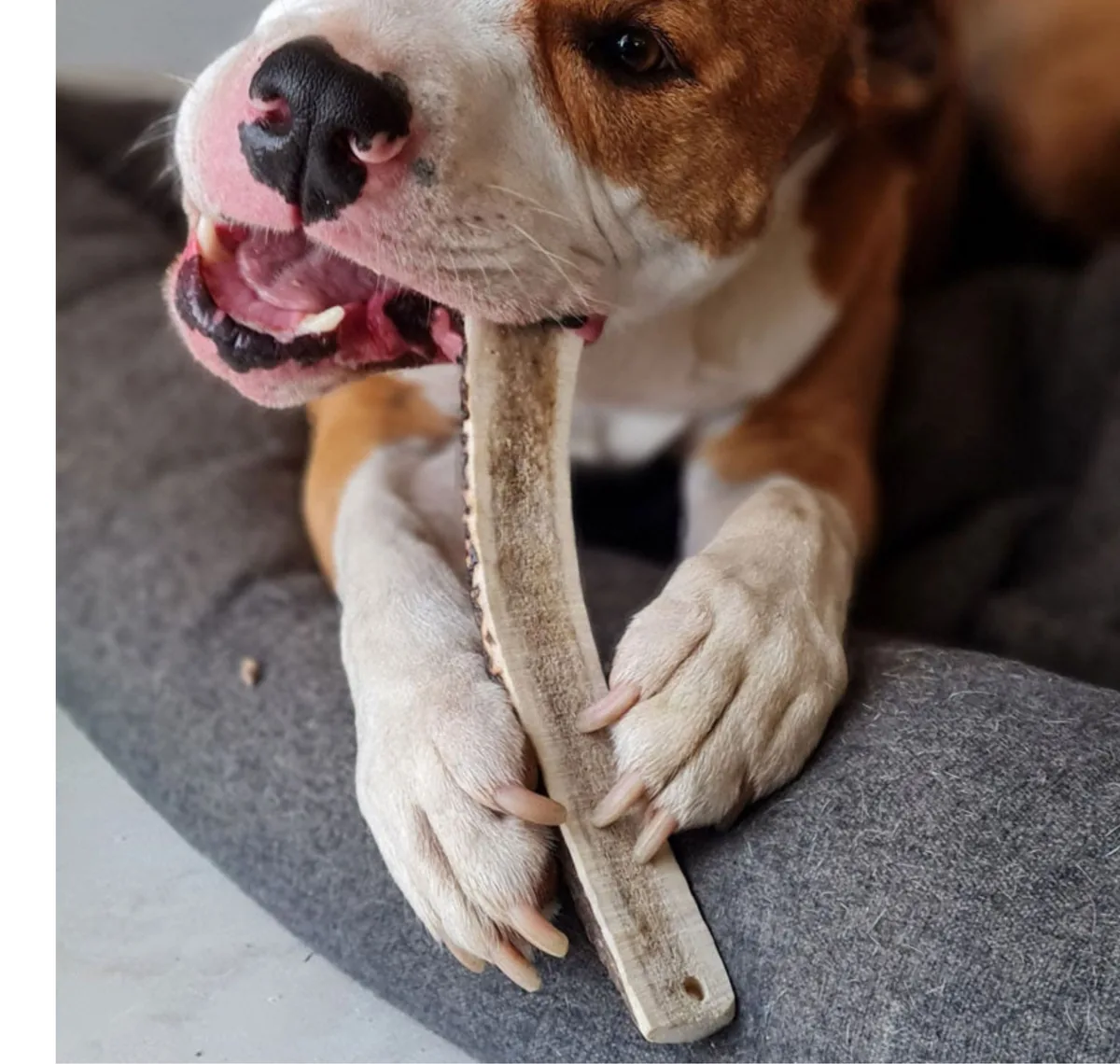
Deer antler is the densest of the group. Its compact structure wears by abrasion: the tooth rasps the surface and releases fine particles, never a splinter. That is what explains how long it lasts, and it is also what makes it a demanding material. It sits right at the limit of the thumbnail test, and the risk is not swallowing but tooth fracture in a dog who crushes. The lengthwise split version is noticeably less hard, since the marrow is accessible from the start.
Buffalo horn is hollow. Once dry, its wall splits into plates with sharp edges that lodge easily in the gum. The central tube also traps residue and quickly turns rancid.
Hooves have the same problem, worse. They shatter into shells with cutting edges, and a hoof swallowed in pieces is among the classic digestive foreign bodies seen in practice.
Of those three, deer antler is the only one whose wear pattern works in the dog's favour. It still has to be given to the right dog.
Processed materials
Rawhide — the white or rolled 'chew bones' — deserves a paragraph of its own, because it is both the best-selling and the most problematic.
It is the inner layer of cattle hide, cleaned and then bleached by chemical treatment. Under saliva it does not wear down: it softens and peels away in slimy strips, which many dogs swallow whole rather than chew. Those strips then swell in the stomach. Choking and intestinal obstruction are the two documented accidents, and safety recalls for bacterial contamination come round regularly in this category.
Cooked bones should never be given. Cooking makes the structure brittle: the bone splits into lengthwise shards with cutting edges. It is the one point on which the whole veterinary profession agrees.
Nylon and so-called indestructible plastics pose a different problem. The shavings that come off do not digest at all, and nylon does not show up on an X-ray: faced with a suspected obstruction, the vet is looking for a foreign body he cannot see.
What those three families share is simple: what the dog detaches can neither dissolve nor digest.
Wood: the one from the garden, and the others
A stick picked up off the ground looks like the most natural option there is. It is in fact the riskiest in this comparison.
Forest wood splits along the grain. It produces long pointed splinters that pierce the palate, the tongue and sometimes the oesophagus. Mouth injuries from sticks are a common reason for consultation, and their seriousness is often underestimated because the wound closes over the splinter still inside.
Then there is the species question. Yew is lethal, even in small amounts and even when dry. Oleander, laburnum and woods of the cherry family are also a problem. Someone picking up a stick almost never knows which tree it came from.
Olive wood and coffee wood behave differently, and that is the whole reason they are in our range. They are dense woods with short interlocking fibres: under the tooth they crumble into small particles rather than splitting lengthwise. They wear down, they get shorter, but they do not produce splinters.
Between the two, coffee wood is softer and lighter, which suits small dogs, seniors and moderate chewers. Olive wood, denser, suits moderate chewers better.
Where our five materials sit
We do not sell five materials out of a taste for catalogues, but because none of them suits every dog. Here is where they sit, limits included.
Whole deer antler — the hardest and longest-lasting. For a determined chewer with healthy teeth who works by abrasion. Rule it out for puppies, seniors and dogs who crush.
Split deer antler — same material, marrow accessible from day one. This is the way in: less effort to reach the flavour, therefore less brute pressure.
Yak cheese — the most forgiving. It softens with saliva, which suits fragile teeth, but it is rich and counts inside the daily ration.
Olive wood — dense, splinter-free, for a regular chewer. Coffee wood — the density of hardwood without the hardness of antler, for small builds and careful jaws.
None of the five removes the rule that applies to all of them: you supervise, and you take the piece away as soon as it is small enough to swallow.
The products that answer this need
- Split deer antlerAll the qualities of deer antler, with the marrow accessible from the start. The best way into natural chew to
- Olive woodThe wood dogs can finally chew toy safely: dense, non-splintering, with a subtle woody flavour.
- Coffee woodThe density of hardwood without the hardness of antler. Our pick for small dogs, seniors and careful jaws.
The questions we get asked
Does deer antler really break teeth?
It can, in a dog who wedges the piece between his molars and bites down sharply — that action risks a fracture on any hard material. In a dog who rasps patiently, the antler wears down before the tooth does. Chewing style therefore matters more than the material itself. If you see the molar bite, drop whole antler and move to split antler or coffee wood.
Is rawhide really dangerous?
The risk is not theoretical. It does not wear down, it peels into strips that many dogs swallow without chewing, and those strips then swell. Choking and obstruction are the two reported accidents, on top of regular recalls for bacterial contamination. If you give it anyway, never leave your dog alone with it.
A stick from the garden is free and natural. Where is the harm?
Two separate problems. Forest wood shatters into long splinters that pierce the palate and the throat. And you almost never know the species: yew is lethal even dry and in small amounts. Wood processed for chewing has neither fault.
Are raw bones better than cooked ones?
They do not share the same flaw: cooking is what makes bone brittle, and a raw bone does not split into cutting shards. That does not make them harmless — bacterial risk, teeth fractured on weight-bearing bones, constipation. They need a precise framework and veterinary advice, which is outside the scope of this comparison.
Which material for a dog who pulverises everything in ten minutes?
Counter-intuitively, not the hardest. A dog who crushes applies brute pressure, and giving him the densest material stages a meeting between two things that will not yield — except the tooth. Move to split deer antler or yak cheese, and accept a shorter lifespan as the price of safety.
Should materials be rotated?
It is good practice. Rotation keeps interest up, stops a dog always working the same part of his mouth, and makes a change in behaviour easier to spot. Nothing requires owning all five, though: two well-chosen materials are enough.
Which chew for your dog?
Four questions, forty seconds. You get the material, the precise size, and above all the reason — including when the answer is “none, not yet”.
Our advice
Understanding your dog's behaviour, and what chewing can change about it.
- My dog destroys everything when I leaveYou come home, the skirting board is gnawed, the sofa gutted. Before looking for a solution…
- My dog is bored: the signs and what to doA bored dog does not sit quietly waiting for it to pass. He invents an activity of his own —…
- Tartar in dogsPeriodontal disease affects the majority of dogs over three years old, and it is almost always…
- Which chew for a puppyA puppy nibbles everything, and that is normal. But most natural chews — ours included — are…
- Senior dogs and chewingAn older dog needs to chew just as much as before. What has changed is not the urge, it is…
The Vitalipets guide
Our choosing guide, free
Join the Vitalipets community: you get our guide “Choosing the right chew” straight away, then our chewing know-how once or twice a month. Never more.
- The guide “Choosing the right chew”, as a PDF and online
- Sent immediately, with no purchase required
- Plain-English advice once or twice a month. No spam
- One-click unsubscribe, any time

Get the guide
Your data stays with us. Never sold, never shared. One-click unsubscribe.