

Yak cheese
Yak cheese for dogs
Three ingredients, a centuries-old Himalayan recipe, and a milky smell very few dogs resist. It is the most appealing product in the range — and the one that calls for the most attention to the daily ration.
What it actually is
Chewable cheese for dogs descends from chhurpi, a traditional hard cheese from the high valleys of the Himalayas. It was not invented for dogs: it is a way of preserving milk in regions where you can neither refrigerate nor transport easily.
The principle is simple. Milk is curdled with a natural acid — here lime juice — the curd is pressed to drive out almost all the water, salted, then left to dry slowly in the cold, dry air of altitude for several weeks.
What remains is a hard, dry, very dense block with almost no moisture. A cheese that keeps for a year at room temperature and which, in a dog's mouth, behaves more like a chewing material than a food.
Three ingredients, and nothing else
Yak and cow milk. Lime juice. Salt. That is the entire composition.
No preservative, no colouring, no flavouring, no binder, no starch, no gluten, no added sugar. Nothing there to hold it together, make it last or make it appealing — longevity comes from the drying, palatability from the milk.
The pieces are shaped and cut by hand, in a workshop running on solar power. Each bar therefore has a slightly different shape and size within its size band: the sign that there is no mould.
Why it contains almost no lactose
This is the question we are asked most, and the answer lies in the making.
Lactose is a water-soluble sugar. When the milk is curdled, the vast majority of it leaves with the whey that is drained off. Pressing removes more. The long drying does the rest.
What remains in a cheese this hard and this dry is residual. That is why many dogs who cannot tolerate a bowl of milk tolerate a chhurpi bar perfectly well.
That said: “almost none” is not “none”. A dog with a known severe intolerance deserves a short first session and observation over the following twenty-four hours, as with any new food.
What it provides — and what must be counted
Yak cheese is rich in protein and calcium. These are the natural values of a pressed, dehydrated cheese, concentrated by the loss of water.
It is also the point to watch with this product, and we would rather say so plainly: it gets eaten. Unlike deer antler, from which the dog only takes in dust, a chhurpi bar ends up in the stomach. It therefore has a real calorie cost.
In practice, count it within the daily ration, particularly for an overweight dog or one on a diet. That is no reason to go without — prolonged chewing actually promotes fullness and occupies the dog away from the bowl — but it is a reason not to add it on top of an already complete ration.
Which dog it suits — and which it does not
It suits the fussy dog. That is its great advantage: the milky smell sparks interest in dogs who ignore everything else. If you have tried three products without success, try this one.
It suits the moderate chewer and the senior dog. The material softens gradually under saliva instead of staying hard, which makes it comfortable for a tired set of teeth.
It suits very small builds, with a size S from 20 to 50 g designed for toy breeds.
It does not suit the dog who gulps. Some dogs do not chew: they swallow. On a material that softens, a hurried dog can detach a piece and get it down whole. If that is your dog's profile, supervise him throughout or choose a material that does not give, such as whole deer antler.
It does not suit a dog with kidney failure or on a low-protein diet without the advice of the vet who follows him. A protein-concentrated product is not trivial in that context.
It does not suit dogs under six months.
Choosing the right size
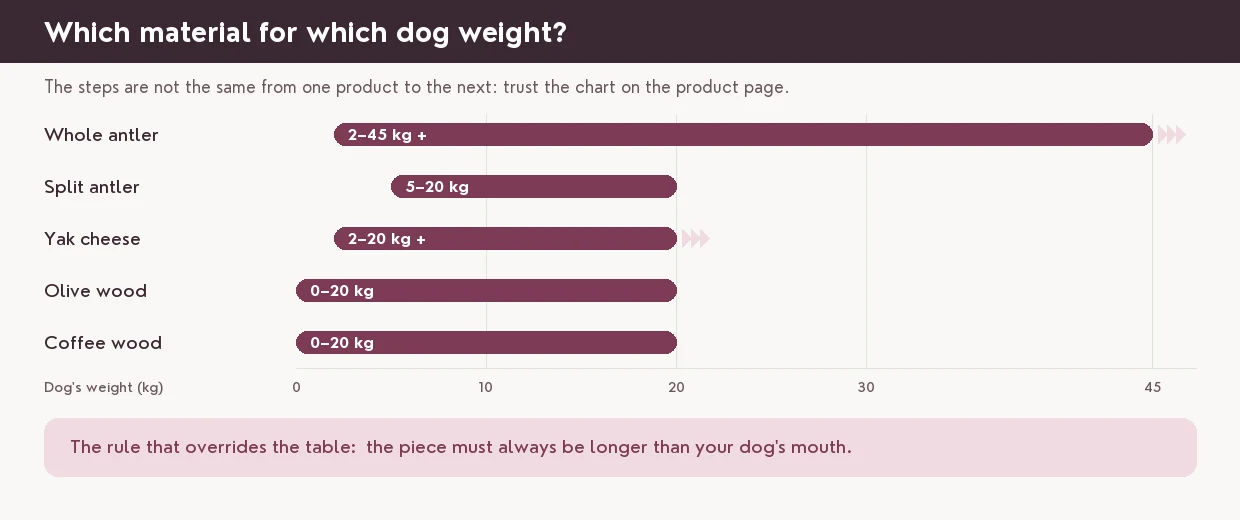
The rule, ahead of any chart: the bar must always be longer than your dog's mouth.
Yak cheese is sized by the weight of the piece. Five sizes: S from 20 to 50 g for toy breeds, M from 50 to 80 g for 5-10 kg, L from 80 to 110 g for 10-15 kg, XL from 110 to 140 g for 15-20 kg, XXL from 165 to 195 g above 20 kg.
The steps are tighter than on the other products — five bands across twenty kilos — because the material softens and loses length faster than a wood. A bar only just long enough at the start becomes too short sooner.
If you hesitate between two sizes, take the larger.
The first sessions
Yak cheese does not call for the same acclimatisation as a very hard material: most dogs get straight to it. The task is not to motivate them, it is to slow them down.
Sessions of 15 to 30 minutes, supervised, then the bar goes away somewhere dry. Left freely available, a motivated dog gets through a whole bar in an evening — and ends up with a stub that is too short before anyone sees it coming.
If your dog chews too fast, lightly dampen the surface before giving it to him. The outer layer softens, he works on that instead of attacking the hard core, and the pace drops.
Conversely, a bar kept dry for a long time can become very hard. The same move — a few drops of water — brings it back to a more workable state.
The last piece: the microwave trick
This is the quirk of chhurpi, and many people discover it too late.
When only a stub of 3 to 4 cm is left — too short to be chewed safely — do not throw it away. Put it on a plate and microwave it for 30 to 60 seconds at full power.
The residual water turns to steam, the cheese puffs up and becomes an airy, crunchy morsel about the volume of a popcorn. Nothing hard about the texture any more.
Let it cool completely before giving it. It comes out boiling in the centre and that does not show from the outside. It is the only precaution, but it is absolute.
This turns the dangerous stub into a safe treat. It is also why a yak bar never ends up in the bin.
When to take it away
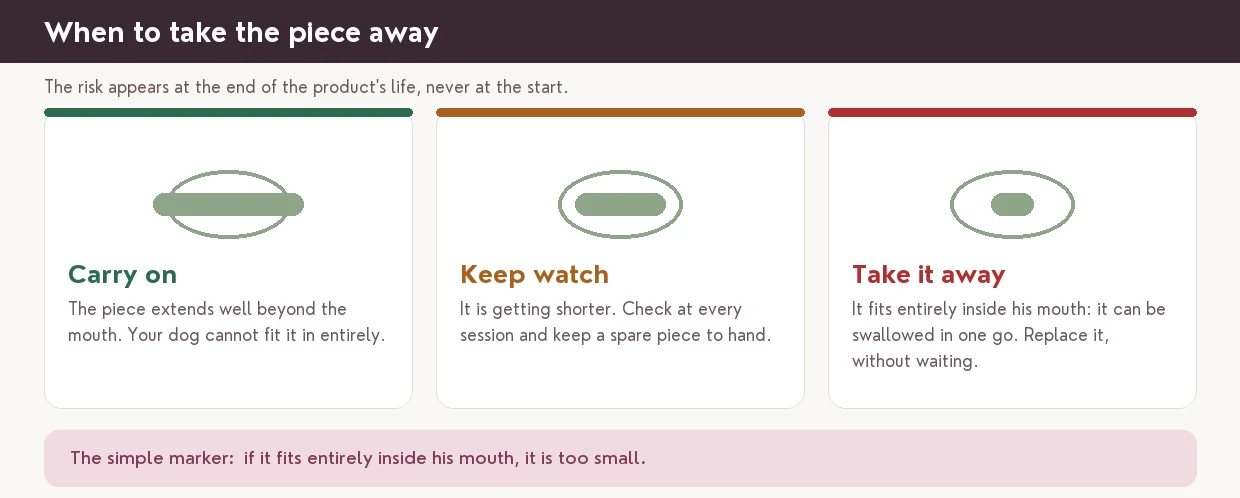
Take the bar away as soon as it becomes small enough to be swallowed whole. The simple test: if it fits entirely inside your dog's mouth, it is too small.
With yak cheese that moment arrives less visibly than with a wood: the bar does not break, it shortens and thins steadily. Get into the habit of eyeing it against your dog's mouth at every session, rather than waiting for a sign.
And remember that the stub you remove is not lost — it goes in the microwave.
The questions we are asked most
“My dog is lactose intolerant, can he have it?” In the vast majority of cases yes, because almost none is left after pressing and drying. Start with a short session and watch the following twenty-four hours.
“Does it smell strong?” It has a clear milky smell, comparable to a mature mountain cheese. Frank but not overpowering, and it leaves no greasy trace on hands or fabrics.
“Is it fattening?” Not if you count it within the ration. It is a concentrated food, to be included rather than added.
“Is it suitable for a puppy?” Not before six months. After that it is one of the most suitable products for a young adult set of teeth, because it gives way gradually.
“How long does it keep?” Twelve months minimum, at room temperature and dry. No refrigeration needed.
Guides by material
A detailed guide for each of our five products.
Our advice
Understanding your dog's behaviour, and what chewing can change about it.
- My dog destroys everything when I leaveYou come home, the skirting board is gnawed, the sofa gutted. Before looking for a solution…
- My dog is bored: the signs and what to doA bored dog does not sit quietly waiting for it to pass. He invents an activity of his own —…
- Tartar in dogsPeriodontal disease affects the majority of dogs over three years old, and it is almost always…
- Which chew for a puppyA puppy nibbles everything, and that is normal. But most natural chews — ours included — are…
- Senior dogs and chewingAn older dog needs to chew just as much as before. What has changed is not the urge, it is…
- Antler, horn, rawhide: what each material is worthThe shelf is crowded and every promise sounds alike. Three questions are enough to place any…
The Vitalipets guide
Our choosing guide, free
Join the Vitalipets community: you get our guide “Choosing the right chew” straight away, then our chewing know-how once or twice a month. Never more.
- The guide “Choosing the right chew”, as a PDF and online
- Sent immediately, with no purchase required
- Plain-English advice once or twice a month. No spam
- One-click unsubscribe, any time

Get the guide
Your data stays with us. Never sold, never shared. One-click unsubscribe.