
Coffee wood
Coffee wood for dogs
The wood of the coffee plant, from the pruning of plantations, with a smooth surface that puts off no dog. Often the best way in for a dog who has never chewed wood — and no, it contains no caffeine.
Let us settle the caffeine question straight away
It is the first question, and a fair one: caffeine is toxic to dogs, at fairly low doses. A careful owner is right to be wary of a product carrying that name.
Here is the answer. In a coffee plant, caffeine is a defence molecule: the plant concentrates it where it protects something, that is in the beans, the leaves and the cherries. The wood of the stem contains no significant amount — it is neither a reproductive organ nor an exposed surface.
Our sticks are cut from the stem, never from beans or leaves. There is no caffeine in this product.
The name is misleading and we understand that. It names the tree of origin, just as “olive wood” names the olive tree — without anyone expecting to find olive oil in it.
Where the sticks come from
A coffee plant is pruned. It is in fact an agronomic necessity: without regular cutting back the plant exhausts itself, grows too tall and becomes impossible to harvest. Every plantation does this pruning, and the wood that comes off is a by-product.
Our sticks come from that pruning. No tree is felled to produce them. The wood that becomes a chew is the wood that would otherwise have been burnt on site.
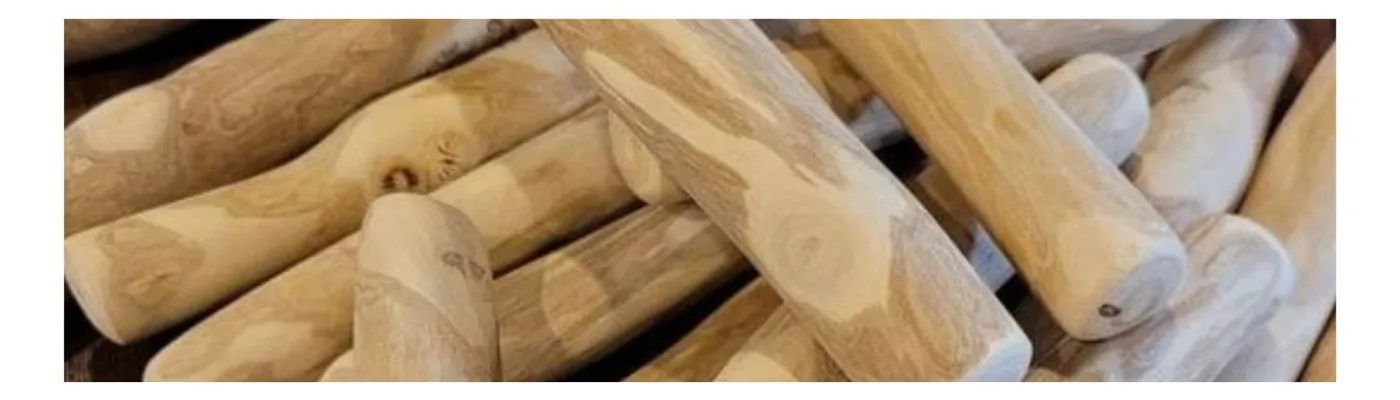
The stems are then dried, cut and sanded by hand in a workshop running on solar power. No treatment, no varnish, no colouring, no additive. The pale tone marbled with beige and brown is that of the wood itself.
As with olive, every stick comes from a real stem: diameter and figure vary from piece to piece.
Why it does not splinter
This is what it shares with olive wood, and the reason for these two species and no others.
A stick picked up in the woods — pine, spruce, willow — has long, parallel fibres. Under a molar it does not wear down: it snaps clean, into sharp splinters that can pierce the palate or the oesophagus. It is a recurring cause of emergency vet visits.
Coffee wood has short, interlocked fibres. Under the same pressure it frays into soft fibres rather than splintering. The dog takes material off; he does not break the piece.
So what you will see: a surface turning downy, ends rounding off, soft fibres at the tips. Remove the ones that grow long — not because they are sharp, but because a dog can swallow them lengthwise.
Reckon on two to four weeks for a medium-sized dog chewing around twenty minutes a day.
Which dog it suits — and which it does not
It suits the dog discovering wood. That is its first quality: smooth surface, discreet smell, nothing intimidating. A dog who has refused an olive wood stick will often accept this one.
It suits the small dog, the senior dog and the moderate chewer. That is its primary purpose. Coffee wood is dense — denser than it feels in the hand — but it remains the more approachable of our two woods: a set of jaws past its prime can work at it without running into the hardness of deer antler.
It suits the dog on a diet, for the same reason as olive: no meaningful calories. The dog occupies himself, works his mind, and takes in nothing.
It suits the dog prone to intolerances. No animal protein, no grain, no gluten, no sugar, no resin.
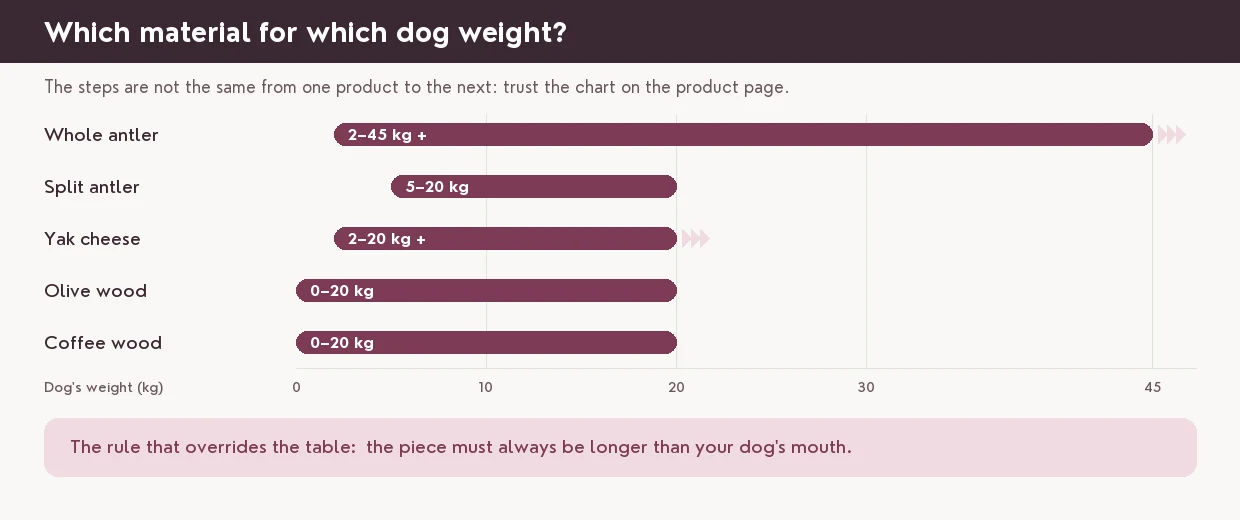
It does not suit dogs over 20 kg. The largest size stops at 15-20 kg. Beyond that, this material does not exist in a suitable size — turn to deer antler.
It does not suit the dog who crushes, the one who tries to snap his toys with a molar rather than wear them down.
It does not suit dogs under six months.
Choosing the right size
The rule, ahead of any chart: the stick must always be wider than your dog's mouth.
Coffee wood is sized by length. Three sizes: S from 12 to 14 cm up to 10 kg, M from 15 to 17 cm for 10-15 kg, L from 18 to 21 cm for 15-20 kg.
Do not carry sizes over from one product to another. A coffee wood “L” is aimed at a 15-20 kg dog; a deer antler “L” at a 20-30 kg dog. The same label means two different dogs.
If you hesitate between two sizes, take the larger. An oversized piece simply lasts longer; an undersized piece is a choking risk.
The first sessions
It is the easiest wood to get adopted, but the same rule applies: jaw and gums need to adjust.
Days 1 to 3: 10 to 15 minutes per session, supervised. Take the stick back afterwards, without making it a conflict — offer a swap.
After that: 20 to 40 minutes a day, in sessions. Inspect the stick after every use and put it away in between: a wood left lying about loses its appeal and wears down unwitnessed.
If your dog loses interest, dampen the surface with a little lukewarm water. The wood then releases more aroma, and that is almost always enough.
Some dogs carry the stick around for days before really starting to chew it. That is normal with both woods. Let him come to it.
When to take it away
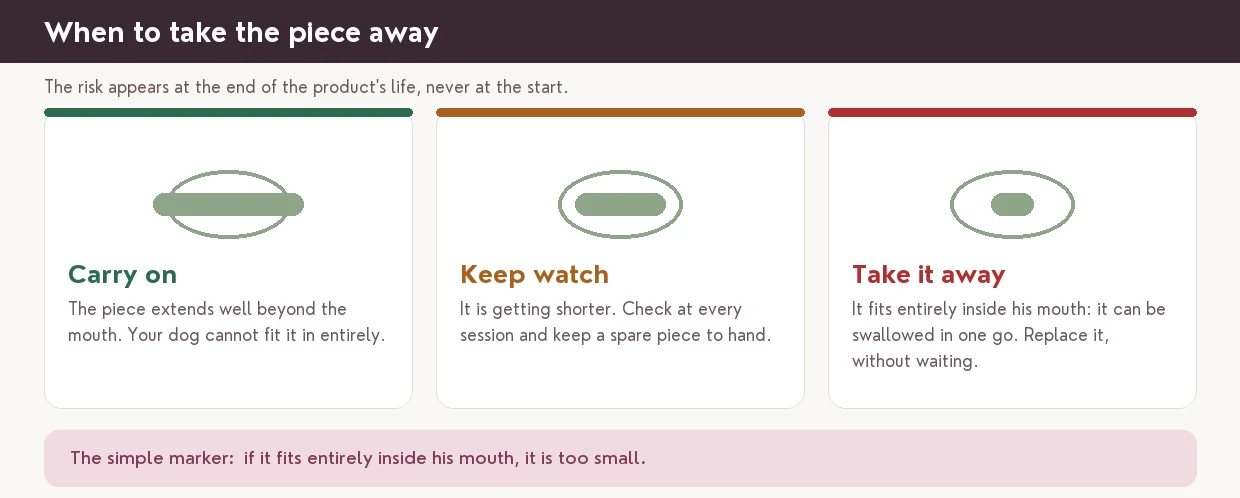
Take the stick away and replace it as soon as it becomes short enough to be swallowed whole. The simple test: if it fits entirely inside your dog's mouth, it is too small.
Two reasons for removal specific to coffee wood: long fibres coming away — remove them as you go — and a stick that splits deeply along its whole length, in which case replace it.
The risk appears at the end of the product's life, never at the start. A reduced fragment can be swallowed in one go and become lodged.
A wood wears down gradually and is therefore easy to miss. Get into the habit of comparing the stick with your dog's mouth at every session, rather than waiting for a signal.
Coffee or olive? How to decide
Our two woods cover exactly the same weight range — up to 20 kg — and are very alike. Here is what genuinely separates them.
Coffee wood has a smoother surface, a more discreet smell, and gives way more easily at the start. It is the better choice for a dog who has never chewed wood, or who has refused some.
Olive wood is denser and lasts longer in the mouth, with a more marked woody scent and a very recognisable grain. It is the choice for a dog who already chews wood without difficulty.
In practice: start with coffee if you are unsure. Move to olive if your dog gets through it too quickly.
And in both cases, the same limit: above 20 kg you have to move to deer antler.
The questions we are asked most
“Really zero caffeine?” Yes. Caffeine concentrates in the beans, leaves and cherries of the coffee plant, not in the wood of the stem — and only the stem is used.
“Can it splinter?” No. Coffee plant fibres are short and interlocked: the wood frays into soft fibres instead of breaking into points.
“My dog swallows the fibres.” Short fibres are soft and pass without difficulty. Remove the ones that grow long, with scissors if need be.
“Does it smell of coffee?” No. The smell is woody and very discreet — which is precisely why you sometimes have to dampen it to spark interest.
“How long does it keep?” Twenty-four months and more, at room temperature and dry. It is dry wood: it does not go off.
Guides by material
A detailed guide for each of our five products.
Our advice
Understanding your dog's behaviour, and what chewing can change about it.
- My dog destroys everything when I leaveYou come home, the skirting board is gnawed, the sofa gutted. Before looking for a solution…
- My dog is bored: the signs and what to doA bored dog does not sit quietly waiting for it to pass. He invents an activity of his own —…
- Tartar in dogsPeriodontal disease affects the majority of dogs over three years old, and it is almost always…
- Which chew for a puppyA puppy nibbles everything, and that is normal. But most natural chews — ours included — are…
- Senior dogs and chewingAn older dog needs to chew just as much as before. What has changed is not the urge, it is…
- Antler, horn, rawhide: what each material is worthThe shelf is crowded and every promise sounds alike. Three questions are enough to place any…
The Vitalipets guide
Our choosing guide, free
Join the Vitalipets community: you get our guide “Choosing the right chew” straight away, then our chewing know-how once or twice a month. Never more.
- The guide “Choosing the right chew”, as a PDF and online
- Sent immediately, with no purchase required
- Plain-English advice once or twice a month. No spam
- One-click unsubscribe, any time

Get the guide
Your data stays with us. Never sold, never shared. One-click unsubscribe.