

Whole deer antler
Deer antler for dogs
The densest chew in our range, and the one that calls for the most judgement. Here is everything worth knowing before you give one to your dog — including the cases where you are better off not to.
An antler is not a horn, and no deer is killed
This is the first thing to understand, and the least well known. A horn — on a cow, a goat, an ibex — grows once and stays attached to the animal for life. It is made of keratin, the same substance as nails, and covers a bony core. To obtain one, the animal has to be killed.
An antler is something else entirely: living bone that regrows every year and falls off on its own.
Deer cast their antlers at the end of winter, between February and April depending on the region. The beam detaches by itself at the base, painlessly, at the coronet. A new one grows within weeks.
Our antlers are gathered from the forest floor after that natural cast. No animal is killed, none is even approached. That sets this product apart from a horn, a hoof or a bone, all of which require slaughter.
The pieces are then cut and sanded by hand, in a workshop running on solar power. Nothing is treated, bleached, dyed or varnished.
Why it lasts months where others last days
The structure of an antler is that of living bone, and it has two layers.
On the outside, a very compact cortex, dense and smooth. It is what resists chewing and explains the product's longevity: your dog only wears it down by abrasion, a little at a time.
Inside, a softer, slightly porous marrow. That is what interests the dog — he works the ends to reach it. On a whole antler the marrow is only accessible through the two sawn ends, and that is the whole difference with the split version.
In practice: one to three months for a medium-sized dog chewing around twenty minutes a day. An intense chewer of large build will be quicker, a moderate dog far slower.
What it provides, and what it does not contain
Deer antler naturally provides calcium, phosphorus, magnesium and collagen. These are the components of bone, present because that is what it is — not because they were added.
It contains no grain, no gluten, no sugar, no added fat, no flavouring, no preservative. For a dog prone to food intolerances it is one of the simplest options to introduce: there is nothing to monitor.
And one detail that matters for life at home: it is odourless and non-greasy. No marks on the sofa, no smell on your hands, no stains on rugs. That is not a marketing point — it often decides whether the product stays in the house or ends up at the back of a drawer.
On calories: prolonged chewing promotes a feeling of fullness and occupies the dog other than through food. Useful for a dog on a diet — and with antler, almost nothing is actually ingested.
Which dog it suits — and which it does not
This is the part of the guide to read in full, even if it talks you out of the purchase.
It suits the regular or intense chewer. The dog who settles down, works his object for twenty to forty minutes, comes back to it day after day, and gets through so-called “tough” rubber in a week.
It does not suit the dog who crushes. Some dogs do not wear their toys down: they try to snap them with a molar. That is a different action from abrasion, and on very hard material it risks a tooth fracture. If your dog does this, look to split antler or yak cheese instead.
It does not suit dogs under six months, whose adult teeth are not yet fully in place.
And it calls for veterinary advice where there has been a tooth fracture, periodontal disease or known fragility. This is not boilerplate: a cracked tooth does not forgive hard material.
Choosing the right size
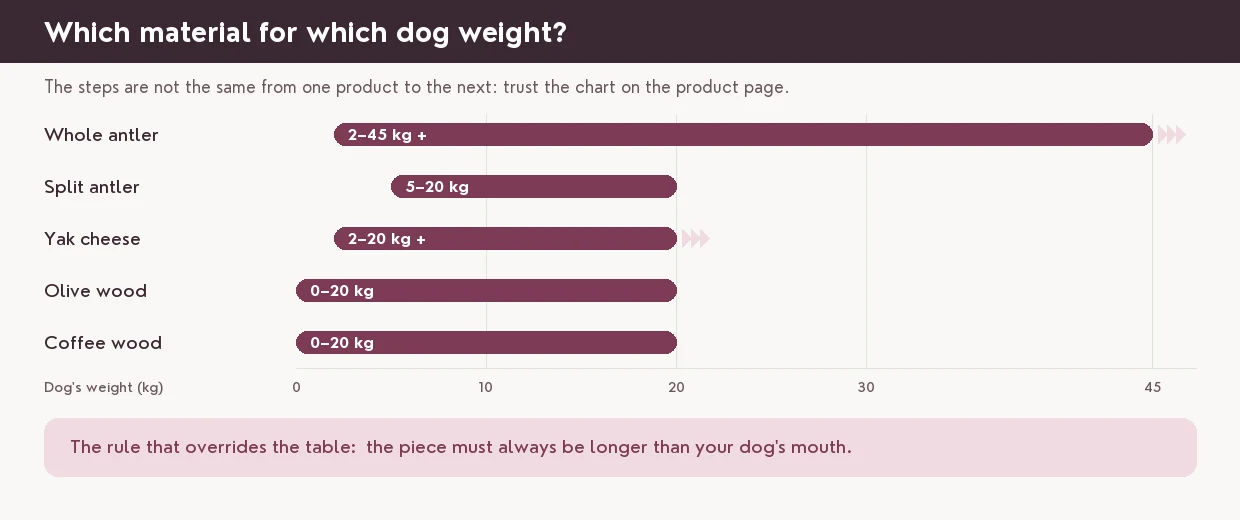
The rule, ahead of any chart: the piece must always be longer than your dog's mouth. As long as he cannot fit it in entirely, he cannot swallow it.
Whole deer antler is sized by the weight of the piece, not its length. Five sizes: XS from 30 to 50 g for toy breeds, M from 88 to 145 g for 5-20 kg, L from 150 to 218 g for 20-30 kg, XL from 219 to 256 g for 30-45 kg, XXL from 257 to 330 g above that. It is the only product in the range that reaches so high: olive and coffee wood stop at 20 kg.
If you hesitate between two sizes, take the larger. An oversized piece has no drawback — it simply lasts longer. An undersized piece is a choking risk.
As a natural product, every piece has a slightly different shape and size within its size band.
The first sessions
Jaw and gums need to get used to material this hard. You do not leave a dog on it for an hour straight away.
Days 1 to 3: 10 to 15 minutes per session, supervised. Take the piece back afterwards, without making it a conflict — offer a swap.
Days 4 to 7: up to 30 minutes, once or twice a day.
After that: 20 to 45 minutes a day, in sessions. It is not an object to leave permanently available — and putting it away between sessions keeps the motivation up.
If your dog shows little interest in the first few days, run the piece under warm water for a few seconds: the moisture revives the smell and is usually enough to trigger interest.
When to take it away
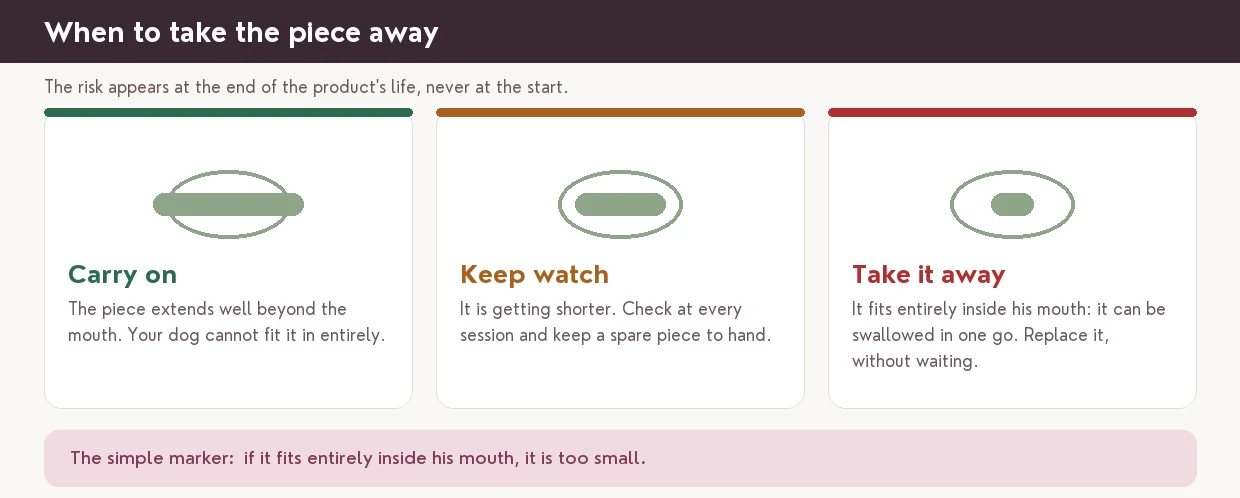
This is the only genuinely critical instruction in this guide.
Take the piece away and replace it as soon as it becomes small enough to be swallowed whole. The simple test: if it fits entirely inside your dog's mouth, it is too small.
The risk appears at the end of the product's life, never at the start. A reduced fragment can be swallowed in one go and become lodged.
Whole or split? How to decide
We offer both, and they are not for the same dog.
The whole antler keeps its cortex intact all the way round. The marrow is only accessible through the sawn ends. That is what gives it its lifespan — and it is also what can discourage a beginner.
The split antler is opened lengthwise: the marrow is exposed along the whole piece. The dog spots it immediately, the smell draws him in, he does not have to earn it.
In practice: if your dog has never chewed hard material, start with the split. If he gets through it in a few days, move to the whole. Succeeding with an accessible product is worth more than failing with the hardest.
The questions we are asked most
“Could my dog break a tooth?” The risk exists with any hard material, and depends more on the dog's action than on the product. A dog who chews by abrasion wears the piece down; one who tries to snap it with a molar puts himself at risk. Watch him on his current toys before deciding.
“Does it smell?” No. It is one of the few chews of animal origin that is completely odourless, because it contains neither fat nor decomposing protein.
“Is it suitable for a puppy?” Not before six months, and not during teething. Hard material has no place on milk teeth.
“How long does it keep?” Indefinitely, at room temperature and dry. No refrigeration, no expiry date: it is mineral matter and collagen.
Guides by material
A detailed guide for each of our five products.
Our advice
Understanding your dog's behaviour, and what chewing can change about it.
- My dog destroys everything when I leaveYou come home, the skirting board is gnawed, the sofa gutted. Before looking for a solution…
- My dog is bored: the signs and what to doA bored dog does not sit quietly waiting for it to pass. He invents an activity of his own —…
- Tartar in dogsPeriodontal disease affects the majority of dogs over three years old, and it is almost always…
- Which chew for a puppyA puppy nibbles everything, and that is normal. But most natural chews — ours included — are…
- Senior dogs and chewingAn older dog needs to chew just as much as before. What has changed is not the urge, it is…
- Antler, horn, rawhide: what each material is worthThe shelf is crowded and every promise sounds alike. Three questions are enough to place any…
The Vitalipets guide
Our choosing guide, free
Join the Vitalipets community: you get our guide “Choosing the right chew” straight away, then our chewing know-how once or twice a month. Never more.
- The guide “Choosing the right chew”, as a PDF and online
- Sent immediately, with no purchase required
- Plain-English advice once or twice a month. No spam
- One-click unsubscribe, any time

Get the guide
Your data stays with us. Never sold, never shared. One-click unsubscribe.