
Olive wood
Olive wood for dogs
The only wood your dog can chew without you having to watch for splinters. It frays into soft fibres instead of breaking into points — and that is all that separates it from a stick picked up in the woods.
Why a stick from the woods is dangerous and this one is not
Every dog owner has thrown a stick at some point. Few know it is a recurring cause of emergency vet visits.
The reason is mechanical. Most woods — pine, spruce, birch, willow, almost anything you find on the ground — have long, parallel fibres. Under the pressure of a molar they do not wear down: they snap clean, producing sharp splinters that can pierce the palate, the tongue or the oesophagus.
Olive has a different structure. Its fibres are short, dense and interlocked, because the tree grows slowly and irregularly. Under the same pressure it does not break: it frays, into soft fibres that come away like hairs.
That is the only reason this product exists. It is not a clean stick: it is a wood whose structure rules out the splinter.
Where the sticks come from
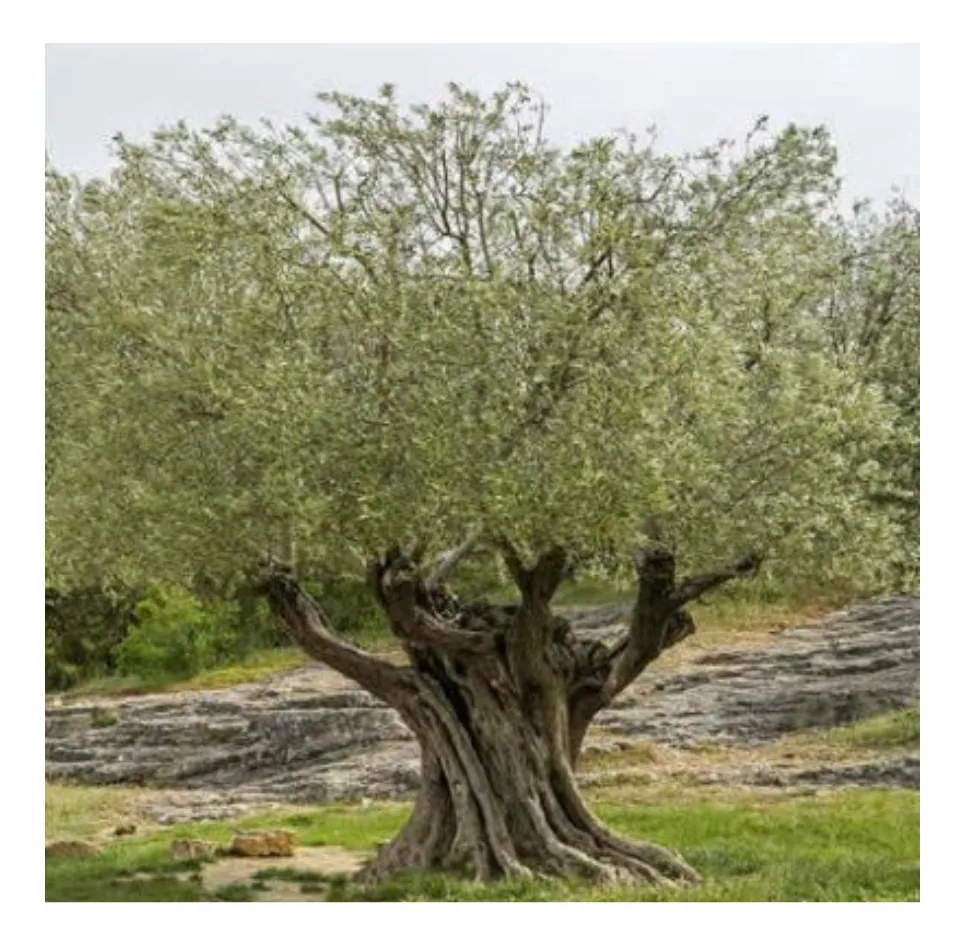
Mediterranean olive groves are pruned every year. It is essential work: without pruning the tree exhausts itself, bears less and grows fragile. The cut wood is a by-product — traditionally it went on the fire.
Our sticks come from that annual pruning. No tree is felled to produce them. That is a difference in kind from most wooden chews, not a shade of wording.
The branches are then sorted, dried, and cut and sanded by hand in a workshop running on solar power. They are neither treated, varnished, oiled nor dyed. The light and dark grain you see on each stick is the natural figure of the wood — which is why no two are alike.
An olive tree can live for centuries and be pruned every year of its life. It is hard to be more renewable than that.
How it wears down, and what you will see
Olive wood is not consumed, it frays. Understanding that avoids two opposite mistakes.
What you will see: soft fibres coming away at the ends, a stick that rounds off, a surface that turns downy. All of that is normal. The fibres are soft, harmless, and most are simply spat out.
Do however remove overly long fibres that hang loose — not because they are sharp, but because a dog can swallow them lengthwise. A snip of the scissors is enough. You can also lightly sand an end that has gone uneven.
What you will not see: sharp splinters. If you do, it is not olive wood.
Reckon on two to four weeks for a medium-sized dog chewing around twenty minutes a day. Longer than yak cheese, shorter than a whole deer antler.
Which dog it suits — and which it does not
It suits the occasional to regular chewer. The dog who settles down, works his stick, comes back to it without trying to destroy it.
It suits the dog on a diet. That is its strongest argument: olive wood provides no meaningful calories. The dog chews, works his mind, calms down — and takes in nothing. For an overweight dog you want to occupy without adding to the ration, there is not much equivalent.
It suits the dog prone to food intolerances. No animal protein, no grain, no gluten, no resin, no sap. There is nothing to monitor.
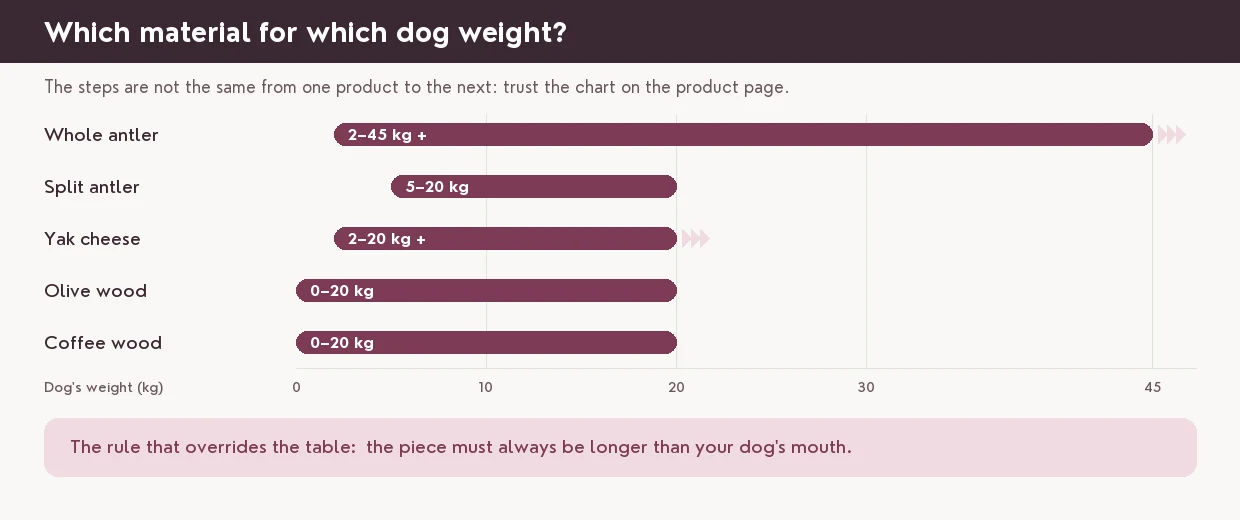
It does not suit dogs over 20 kg. The largest size stops at 15-20 kg. Beyond that, no suitable size exists in this material — turn to deer antler. That is a limit of the product, and we would rather say so than sell you an L that is too small.
It does not suit the dog who crushes, the one who tries to snap his toys with a molar rather than wear them down.
It does not suit dogs under six months.
Choosing the right size
The rule, ahead of any chart: the stick must always be wider than your dog's mouth.
Unlike deer antler, olive wood is sized by length, not weight. Three sizes: S from 12 to 15 cm up to 10 kg, M from 15 to 20 cm for 10-15 kg, L from 20 to 25 cm for 15-20 kg.
Watch out for the trap: an olive wood “L” has nothing to do with a deer antler “L”. The first is aimed at a 15-20 kg dog, the second at a 20-30 kg dog. Sizes do not carry over from one product to another.
If you hesitate between two sizes, take the larger. An oversized piece simply lasts longer; an undersized piece is a choking risk.
Since every stick comes from a real branch, its diameter varies within its size band.
The first sessions: patience first
This is olive wood's quirk, and the main cause of disappointment. Many dogs are not interested straight away.
The wood has almost no smell, no marked taste at first, and nothing resembling food. A dog used to treats may carry it, put it down, come back three days later, and only then start working it.
Do not press it on him. Leave it where the dog passes by. This is a product that gets adopted, not one the owner imposes.
Two things that help: run the stick briefly under lukewarm water — the moisture releases the woody scent — or rub it between your hands before giving it.
Once he is going, the usual rhythm: 10 to 15 minutes supervised in the first days, then 20 to 40 minutes a day in sessions. Check the stick's condition after every session and put it away in between.
When to take it away
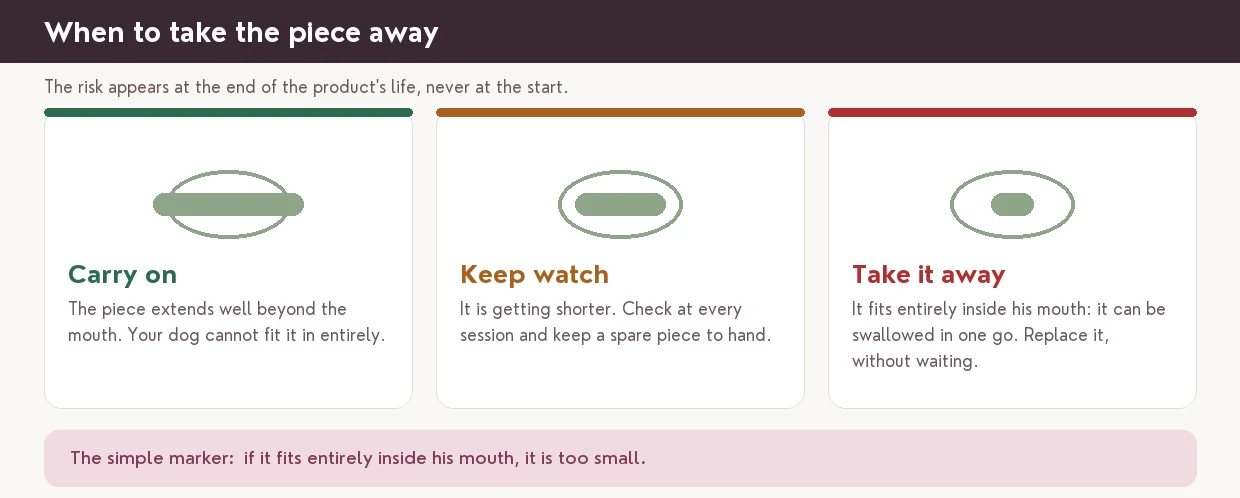
Take the stick away and replace it as soon as it becomes short enough to be swallowed whole. The simple test: if it fits entirely inside your dog's mouth, it is too small.
One reason for removal specific to olive wood: if the stick splits deeply along its whole length, replace it. A through-crack changes how the wood behaves — the piece can open in two and release fragments whose size is no longer controlled.
A shallow surface crack, on the other hand, is part of normal wear.
Remove long hanging fibres as you go, without waiting for the replacement.
Olive or coffee wood? How to decide
These are our two woods, they cover the same weight range — up to 20 kg — and they look alike on paper. Here is what genuinely separates them.
Olive wood is the denser of the two and lasts longer in the mouth. It has a light woody scent and a marked grain that makes it recognisable. It is the choice for a dog who chews consistently and is already used to wood.
Coffee wood has a smoother surface, a more discreet smell, and gives way more easily at the start. It is often the better one for a dog who has never chewed wood in his life.
In practice: if your dog has already refused a stick, start with coffee. If he already chews wood without difficulty, olive will last longer.
And in both cases the same limit: above 20 kg, neither exists in a suitable size.
The questions we are asked most
“Can it splinter?” No, and that is the whole reason the product exists. Olive frays into soft fibres instead of breaking into points. It is a property of its structure, not an applied treatment.
“My dog swallows the fibres, is that serious?” Short fibres are soft and pass without difficulty. Remove the ones that grow long.
“He is not interested at all.” Give him three days without doing anything, then dampen the stick with lukewarm water. It is the most common case with this material, and it almost always resolves itself.
“Does it damage teeth?” The risk exists with any hard material and depends more on the dog's action than on the product. A dog who chews by abrasion risks nothing; a dog who crushes should abstain, here as elsewhere.
“How long does it keep?” Twenty-four months and more, at room temperature and dry. It is dry wood: it does not go off.
Guides by material
A detailed guide for each of our five products.
Our advice
Understanding your dog's behaviour, and what chewing can change about it.
- My dog destroys everything when I leaveYou come home, the skirting board is gnawed, the sofa gutted. Before looking for a solution…
- My dog is bored: the signs and what to doA bored dog does not sit quietly waiting for it to pass. He invents an activity of his own —…
- Tartar in dogsPeriodontal disease affects the majority of dogs over three years old, and it is almost always…
- Which chew for a puppyA puppy nibbles everything, and that is normal. But most natural chews — ours included — are…
- Senior dogs and chewingAn older dog needs to chew just as much as before. What has changed is not the urge, it is…
- Antler, horn, rawhide: what each material is worthThe shelf is crowded and every promise sounds alike. Three questions are enough to place any…
The Vitalipets guide
Our choosing guide, free
Join the Vitalipets community: you get our guide “Choosing the right chew” straight away, then our chewing know-how once or twice a month. Never more.
- The guide “Choosing the right chew”, as a PDF and online
- Sent immediately, with no purchase required
- Plain-English advice once or twice a month. No spam
- One-click unsubscribe, any time

Get the guide
Your data stays with us. Never sold, never shared. One-click unsubscribe.